Marker Pen Font: Bold, Consistent Branding for Small Businesses
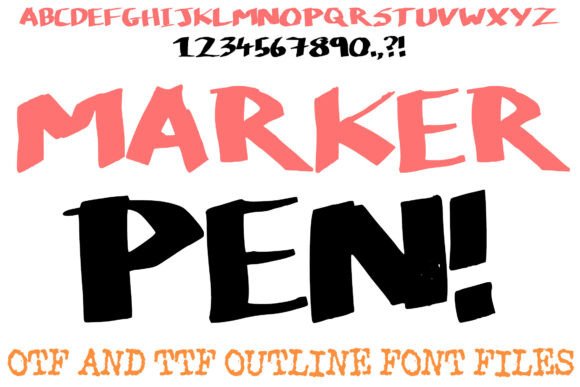
If you’ve ever spent hours tweaking a logo only to feel like it still lacks energy—or printed product labels that vanish into the background—then you know how much weight a single typeface carries in shaping how customers see your business. The Marker Pen font isn’t just another display font. It’s a hand-inked, wide-tip permanent marker typeface with heavy strokes, raw edges, and unmistakable presence. Designed for impact—not subtlety—it gives your brand an immediate visual voice: confident, approachable, and authentically human.
As a small business owner who designs most of my own marketing materials—from café menu boards to candle jar labels—I’ve learned that consistency starts with typography. When every customer touchpoint uses the same expressive yet intentional font, your brand feels more cohesive and trustworthy—even before someone reads a word. Marker Pen works especially well for businesses where personality matters: handmade goods, local food brands, wellness services, creative studios, and boutique retail. Its aggressive energy doesn’t shout over your message—it amplifies it.
Where Marker Pen Makes Real Business Sense
You don’t need a designer on retainer to use Marker Pen effectively. Here’s where it delivers tangible value across everyday business materials:
- Product labels and packaging: A candle maker using Marker Pen on a kraft paper label instantly communicates craft and authenticity. Its thick strokes hold up beautifully at small sizes (down to 10–12 pt) when printed on matte stickers or embossed tags.
- Menus and signage: For cafés or food trucks, Marker Pen adds warmth and immediacy to chalkboard-style menus—without the smudging. It scales cleanly from large wall banners to compact QR code cards.
- Social media graphics: On Instagram or Pinterest, Marker Pen headlines pop in thumbnails. Paired with clean body text, it creates contrast that stops scrollers without sacrificing clarity.
- Business cards and thank-you notes: Handwritten fonts can feel too casual—but Marker Pen bridges that gap. It feels personal, not unpolished, especially when used for names, taglines, or short calls-to-action.
- Websites and digital ads: As a web-safe display font (when properly embedded), it strengthens hero sections, email headers, and limited-edition sale banners—always as a headline or accent, never body copy.
Using Marker Pen Without Losing Readability
Marker Pen is a display font, not a workhorse. That means it shines brightest where attention is needed—not where long paragraphs live. Use it for logos, shop signage, product names, social post headlines, and promotional banners. Avoid setting full paragraphs or fine print in Marker Pen; its boldness can fatigue the eye in extended reading.
On mobile screens, test how it renders at smaller sizes. While it remains legible down to ~14 pt in headings, avoid using it below 16 pt in digital ads or app interfaces unless paired with generous spacing and high-contrast backgrounds. For printed packaging, ensure ink coverage and paper stock support its dense strokes—glossy finishes often enhance its marker-like sheen.
Pairing Marker Pen With Other Fonts
No display font stands alone. Marker Pen gains strength—and professionalism—when paired thoughtfully. Think of it as your brand’s “voice,” and the supporting font as its “clarity.”
A clean, neutral sans serif—like Montserrat, Inter, or Open Sans—creates reliable contrast. Use Marker Pen for your shop name or special offer, and the sans serif for ingredients, descriptions, or contact details. This pairing works equally well on a beauty product box, coaching service website, or online shop banner.
For warmer, more traditional brands—a family-run bakery or heritage textile shop—try pairing Marker Pen with a gentle serif like Merriweather or Lora. The contrast between expressive headline and grounded body text reinforces both creativity and credibility.
Testing Before You Commit
Before applying Marker Pen across all your assets, run simple tests: Print a mock-up label at actual size. Paste a sample headline into your Instagram Stories editor. Drop it into your Shopify homepage banner preview. Does it hold up next to your logo? Does it feel aligned with your brand’s tone—not too loud for a meditation studio, not too soft for a streetwear brand?
Many small business owners start by using Marker Pen in just one place: their product launch graphic, a seasonal sale banner, or a new line of stickers. That low-risk trial helps confirm whether its energy matches your audience’s expectations—and gives you confidence before scaling it across packaging or web design.
Licensing Matters—Especially for Products
Marker Pen is a premium font designed for real-world business use—but always verify its commercial license before deploying it on physical products. Most reputable vendors grant broad usage rights, including embedding in packaging, printing on merchandise, and using in client-facing templates. However, if you sell digital downloads (like Canva templates or printable planners), double-check whether the license permits redistribution. When in doubt, contact the foundry directly. A clear license protects your time, reputation, and revenue.
More Than Just a Font—A Brand Anchor
What makes Marker Pen different isn’t just how it looks—it’s how it behaves across your business. It’s consistent enough to become recognizable on a shelf or in a feed. It’s distinctive enough to stand out among competitors using generic system fonts. And it’s versatile enough to adapt across mediums without losing its character.
Whether you’re launching your first candle collection, redesigning your café’s takeout bags, or refreshing your coaching business’s website visuals, Marker Pen offers a shortcut to stronger visual identity—not through complexity, but through intentional, human-made expression. It reminds customers that behind every product, there’s a person. And sometimes, the boldest statement you can make is simply showing up—clearly, confidently, and unmistakably yours.